
In B2B commerce, the growth of a brand does not rely solely on the quality of its products. It also depends on customer coverage—that is, the ability of sales teams to be present in the field with all of their distributor clients.
Because beyond taking orders, a sales representative’s visit is also a moment for exchange, advice, follow-up, analysis and building a high-quality business relationship.
So, how can you ensure that your salespeople are visiting, following up and reaching out to all of your clients?
Forgetting a client may seem minor. In reality, for brands, these oversights come at a cost: lost sales, weakened business relationships due to lack of support, or even commercial opportunities left to competitors.
In this article, we will explore how these oversights can occur and how digital tools can help your sales teams reduce them.
1. Why is it still common to forget clients?
Visit planning often relies on the experience of the salespeople. They know their territory, their portfolio, and their current priorities… but this intuitive organization has its limits. When activity intensifies, requests pile up, urgent matters take precedence, and some visits may fall by the wayside.
Several factors explain why some clients end up being forgotten:
- Management based on scattered notes or Excel files
Handwritten notes or spreadsheets can help temporarily but quickly become a barrier to effective sales organization. Without structured history, automatic alerts, or visibility on inactive clients, maintaining regular and effective follow-up becomes difficult.
- A very large sales portfolio
In some sectors, a salesperson may manage a portfolio of over a hundred clients. Without the right tools, client follow-up becomes a challenge, and some visits inevitably slip through the cracks.
- A tendency to always focus on the same clients
Salespeople naturally tend to prioritize clients who order regularly, leaving occasional clients aside—clients who, in fact, should be closely monitored.
- Lack of centralized data
When visit reports, order history, follow-ups, or disputes are not consolidated in a single space, getting a real-time overview is complicated, and setting priorities becomes harder.
This lack of centralization also complicates the handover process when a salesperson changes or during internal reorganization: part of the client knowledge is lost along the way.
- No customer coverage indicators
Without precise indicators such as the percentage of clients visited, inactive clients, or date of last visit, measuring field performance is impossible.
Thus, to ensure complete and effective coverage, it becomes essential to have tools that can centralize information to provide a clear view of field activity.
2. Customer coverage: a key metric for B2B brands
Customer coverage measures the proportion of clients visited or contacted over a given period.
This metric allows you to:
- Immediately detect forgotten or inactive clients
- Optimize the planning of sales visits
- Balance portfolios among salespeople
- Identify undercovered areas to adjust strategies
- Set realistic goals based on reliable data
Beyond the numbers, customer coverage reflects the vitality of your sales network. A store that hasn’t been visited, a shop that hasn’t placed an order in several months, or an unnoticed drop in activity are all warning signs.
Insufficient coverage can have short- and long-term consequences:
- Lost revenue from missed orders: Without regular contact, orders are postponed or lost to competitors
- Decreased client loyalty and satisfaction: A poorly followed-up client feels less prioritized and becomes less engaged
- Lack of field insights: The absence of planned visits prevents detection of trends, product performance, and purchase habits
- Loss of visibility on the actual network state: It is difficult to manage a sales force without knowing which clients have been seen, when, how often, and in what context
For salespeople, the challenge is not just to sell. It is also to maintain continuous relationships, identify opportunities, and secure revenue over time.

3. How digital tools help field salespeople better manage their client portfolios ?
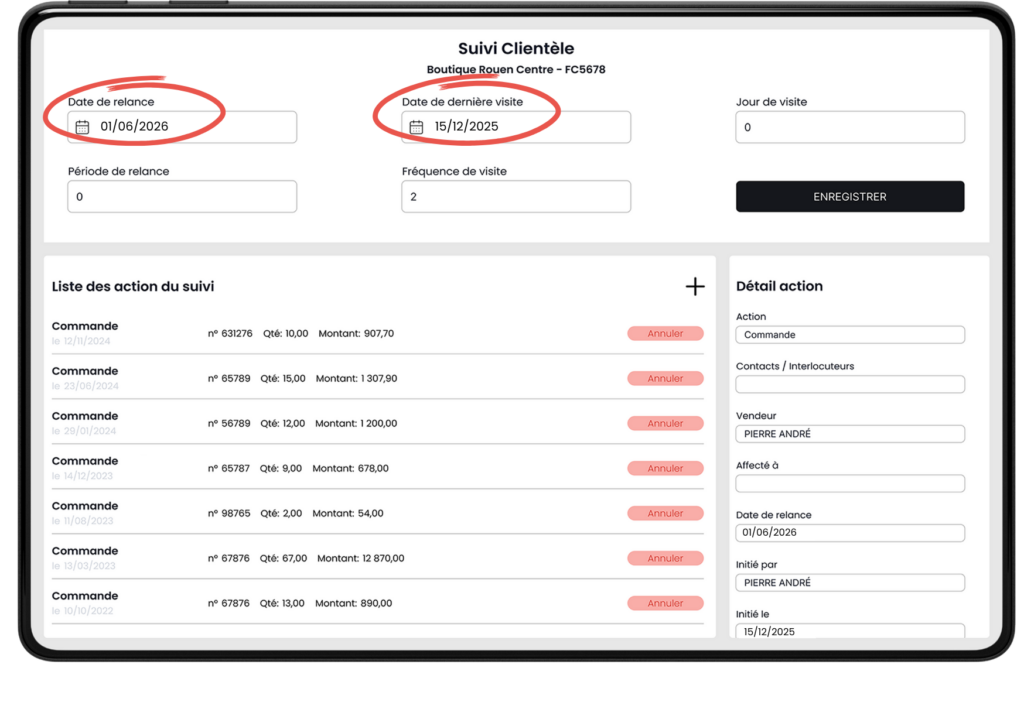
In the field, salespeople need a clear, fast, and unified view of all essential information to prepare their visits and set priorities. A complete client record that includes order history, last visit date, key contacts, follow-ups, outstanding balances, and credits becomes a true support for organizing sales activities.
At a glance, the salesperson knows the status of their territory. But this visibility is only useful if it is also shared with management, which can track customer coverage, anticipate risk areas, and rebalance efforts if necessary.
Several tools complement each other for this purpose:
✔ A mobile app equipped with a CRM and enriched client records:
- 360° view of each client: With enriched client records centralized in a CRM, all information is consolidated, updated, and shared between salespeople and managers.
- Alerts for visit prioritization: The tool automatically identifies clients who haven’t been visited in weeks and flags those needing special attention, allowing efficient route planning.
- Active follow-up management: Salespeople can record and track all planned follow-ups to ensure no client is forgotten or left without response.
- Concrete visit traceability: Every action is documented—contacts, visit reports, comments, photos, orders… Managers and salespeople share the same information without duplicate entry.
✔ A dashboard as a statistical tool to manage sales activity:
To go further in management, an integrated statistical tool allows monitoring of activity and anticipating client needs. For example, the “Cadencier” module in the Quickorder SFA mobile app provides access to accurate statistical history per client and allows you to immediately view in a dashboard ordering habits by week, month, quarter or year. Salespeople can quickly detect inactive clients, identify sales variations, and adjust their strategy to ensure optimal customer coverage.
✔️ A B2B platform as a complementary interaction channel to maintain relationships under any circumstances:
Beyond the mobile app, a B2B e-commerce platform serves as a valuable relay to ensure service continuity. Salespeople have dedicated access to monitor client activity remotely—covering distant stores, limited availability, or scheduling constraints.
This digital channel allows ongoing contact, supports points of sale, and secures restocking even when physical visits are not possible. It naturally integrates into the customer coverage strategy by providing regular, smooth, multichannel commercial presence.
Together, these tools offer salespeople and management a complete and shared view of the client portfolio, ensuring optimal coverage and effective follow-up.
4. Don’t let chance determine the quality of your business relationships
In a competitive environment, field presence remains a strategic advantage. But it must be organized, documented, and managed to be truly effective.
Brands that master their customer coverage gain responsiveness, consistency, and quality support. They know which stores need revisits, which are inactive, progressing, or declining… They can better allocate their sales forces, organize their visits efficiently, and fill gaps in client follow-up, which could otherwise become costly.
Digital tools reinforce the efforts of salespeople to maintain regular, smooth, and lasting business relationships. By combining field presence, CRM, and B2B platforms, brands have a complete system to maintain strong and continuous commercial ties with their distributor clients.
See also
B2B Loyalty: 5 strategies to build long-lasting customer relationships using digital tools