
At many B2B companies, field sales reps juggle customer meetings, visit preparation, product presentations, order taking, follow-ups, visit reports, and administrative tasks every day.
Their days are therefore filled with multiple steps before, during, and after each customer meeting. When these activities rely on disconnected tools or require information to be entered multiple times, a significant portion of their time is taken up by administrative tasks that could be simplified through digital solutions.
This is precisely the challenge that SFA (Sales Force Automation)software is designed to address. By centralizing sales information and automating many tasks, these tools help sales teams work more efficiently, reduce errors, and deliver a better customer experience.
An SFA app should support sales reps throughout the entire sales process: from preparing customer visits to managing customer relationships, including presenting the product offering and taking orders.
To help you choose the right solution, here are 7 essential features that SFA software should offer to effectively support your B2B sales team.
1. Fast, simple and reliable order-taking.
Once customer needs have been identified, negotiations completed, and the sale agreed upon, the order should be processed quickly and efficiently.
An overly complex ordering process, repeated data entry, or poorly suited tools can slow down the sales cycle and lead to errors that affect service quality.
SFA software should therefore enable sales reps to finalize sales easily with time-saving features such as :
- Duplicating an existing order
- Creating an order based on the customer’s purchase history
- Quickly searching for products
- Scanning barcodes
- Automatically applying negotiated commercial terms and calculating discounts
- Obtaining electronic signatures on order forms.
Once approved, the order is immediately sent to headquarters, with no need for further data entry. This gives internal teams access to reliable information and allows them to move more quickly to order processing and delivery.
Sales reps can then focus fully on what they bring the most value to: building customer relationships and generating new sales opportunities.
2. A digital catalog personalized for each customer.
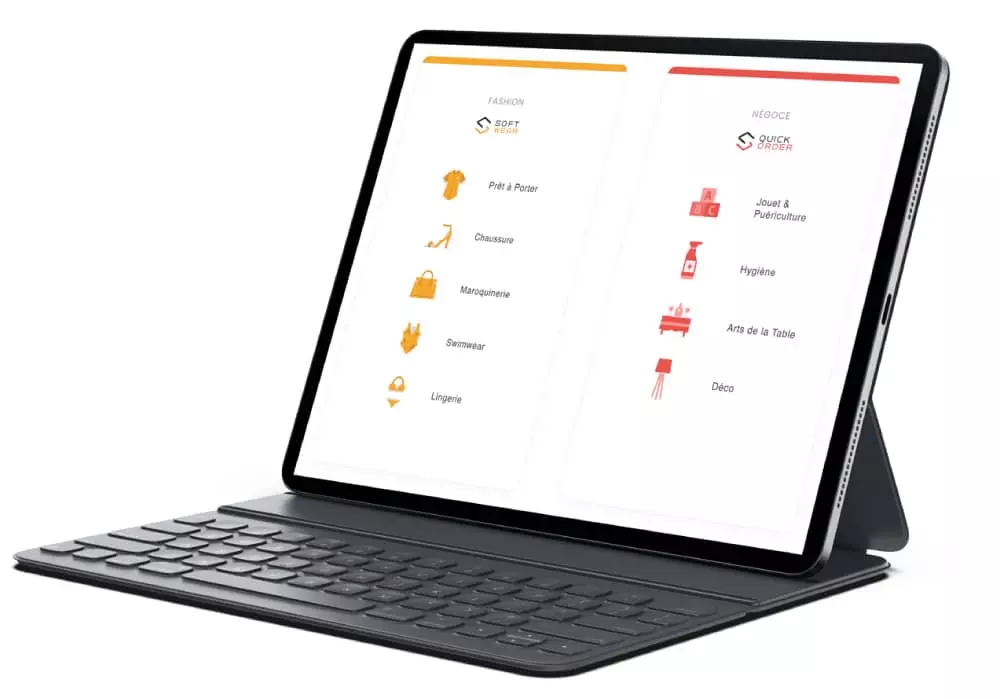
More than just a product presentation tool, a digital catalog becomes a valuable sales tool. It enables field sales teams to present a clear, attractive, and personalized product offering based on each customer’s profile, needs, and purchasing habits.
With up-to-date information and enriched content, sales reps have everything they need to showcase products effectively and make purchasing decisions easier.
A high-performance digital catalog can, in particular :
- Automatically display the products listed for each customer
- Apply negotiated prices and commercial terms
- Highlight new products and collections
- Include high-resolution photos, videos, technical specifications and lifestyle imagery
- Recommend complementary products to encourage additional sales

This personalization not only improves the customer experience but also makes it easier for customers to make decisions during meetings.
Access to up-to-date inventory information is another major advantage. Sales reps can immediately inform customers about product availability, suggest alternatives when items are out of stock, and check outstanding backorders and upcoming deliveries.
3. An app that works even without an internet connection.
Field sales reps work in all kinds of locations: areas with no network coverage, warehouses, trade shows, and even inside buildings where connectivity can sometimes be unreliable.
In these situations, an app that depends on an Internet connection can quickly become an obstacle to making sales.
That is why offline functionality remains an essential feature.
Even without network access, sales reps should be able to :
- View their customer accounts
- Access the product catalog
- Create quotes
- Save orders
- Prepare customer visits
Data is then automatically synchronized as soon as the connection is restored.
This ensures that sales reps remain fully operational, whatever the conditions in the field.
4. Integrated CRM to build stronger customer relationships.
Every interaction with a customer is an opportunity to better understand their needs and build a lasting business relationship.
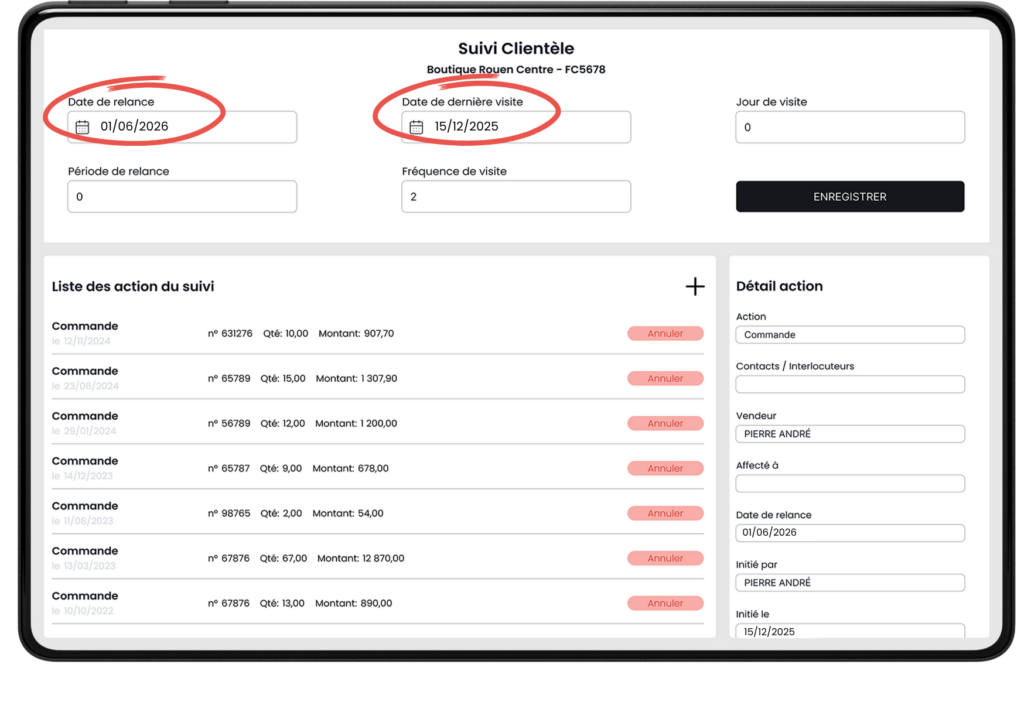
SFA software with an integrated CRM tool centralizes all the information needed to manage customer relationships :
- Order history
- Recent communications
- Outstanding quotes
- Visit reports
- Sales opportunities
- Follow-up actions
Sales reps therefore have a complete overview of each customer, enabling them to prepare for meetings more effectively and offer more relevant products and services.
Sales managers, in turn, gain an overview of their team’s activities and can more easily monitor the development of the customer portfolio.
5. A solution tailored to the specific needs of your industry.
Every industry has its own sales practices, constraints, and ways of working. The needs of a fashion brand differ from those of a manufacturer or a distributor in the wholesale and distribution sector.
That is why good SFA software must be flexible enough to adapt to the specific requirements of your business.
For example, in the fashion industry, sales reps need to work with collections, seasons, sizes, colors, packs, assortments, and more.
For international operations, the solution must also support multiple languages, currencies, price lists, and commercial regulations.
The better your software fits your business, the more efficiently your teams can work every day.
6. ERP integration to ensure reliable data.
SFA software should never operate in isolation. To eliminate duplicate data entry and ensure consistent information, it must communicate with your ERP system.
This integration makes it possible to automatically retrieve :
- Customer data
- Product information
- Prices
- Promotions
- Inventory levels
- Orders
Information can then flow seamlessly between field sales reps, sales administration, logistics, and sales management teams.
The result: fewer errors, faster order processing, and better service quality.
Before choosing an SFA solution, it is therefore essential to check that it is compatible with your ERP system.
7. Dashboards to monitor sales performance.
In addition to supporting sales reps in their day-to-day activities, SFA software also gives managers a clear overview of field sales activity.
Using data collected during customer visits, sales managers gain access to reliable performance indicators to analyze results, monitor progress toward targets, and identify areas for improvement.
Dashboards can be used to track key performance indicators such as :
- Revenue generated
- Progress toward sales targets
- Performance by sales rep or territory
- Frequency of customer visits
- Customers requiring follow-up or not visited often enough
- Sales trends by product category
These insights help managers better oversee sales operations, adjust field priorities, and support their teams with a clear, data-driven approach.
Beyond the technology itself, the right digital tool is above all one that fits your sales processes and supports your company’s long-term growth.
If you are considering digitizing your sales team or replacing your current solution, take the time to assess these seven features. They can make all the difference in the field… where sales performance is built.
See also
B2B customer coverage: How to achieve a complete follow-up of your retailers ?